School’s In. So Are 60,000+ New SKUs.

Our newest catalog update includes 60,000+ new products across food and non-food categories for Back-To-School, from lunchbox snacks to school supplies. Plus, expanded coverage of private label products and exclusive items from top retailers.
Catalog
3 min read
Author:
David Goodtree
Date:
August 12, 2025
Subscribe

Subscribe to receive our latest news direct to your inbox.

Our v40 catalog now includes 800,000+ products, an increase of 27% year to date.

Back to School - And Beyond the Snack Aisle

Each catalog captures new products and updated data and images. Whether your application is product matching, enrichment, or analytics, we’ve got the data. Here are a few of the product introductions in our newest release:
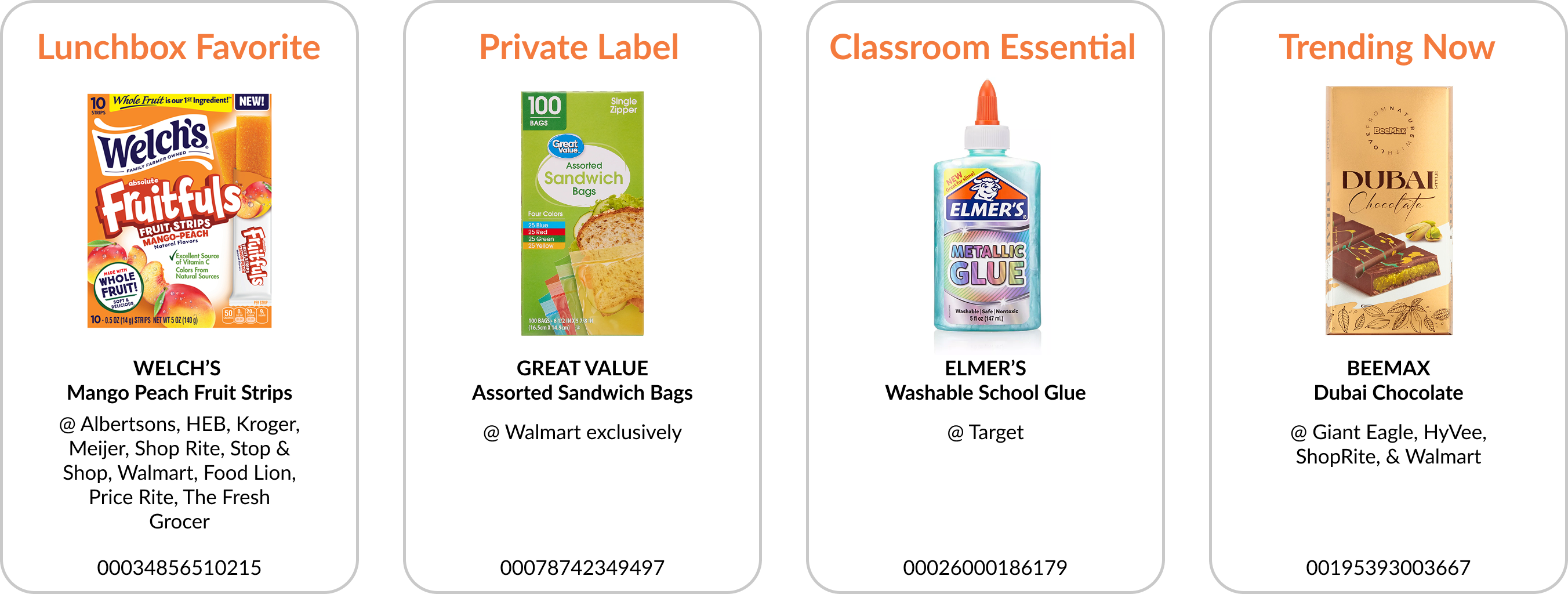
Dubai Chocolate is a new flavor and it’s trending.  (It’s delicious, too). Using AI analytics, we found that at Christmas last year, no major retailers were offering any Dubai Chocolate products. But in our newest catalog, we see that 12 different brands are currently offered in retailers across the USA. Foodgraph's catalog is always up-to-date with new product introductions and useful analytics.

In addition to packaged food products, we’re continuing to expand coverage across all aisles of the store, adding items in Household, Personal Care, Health & Beauty, and Pets. And more to come!

Retailer Assortments: Who's Winning?

Each retailer’s unique mix shows how they stack up as a “destination” store.

Notice that Price Chopper and Stop & Shop have the lowest unique mix, which is expected for supermarkets.  Compare them to Sprouts and Whole Foods, which are specialty retailers, and Walmart with its high percentage of private label products.

Our AI classifier agent and product matching algorithms enable high-value analytics across categories, retailers, attribute compliance, and much more.

New Retailers Added

Foodgraph’s catalog has grown to include product data from 29 sources, adding four new sources since our last release, including the packaged food products from these major retailers.

Next Catalog Update

Looking ahead, our next major update is planned for September, with a spotlight on fall flavors and Halloween products.

Thank you for following our progress! If you need more information, feel free to reach out. I’d love to hear how we can support your work.

David

David Goodtree

Founder and CEO, Foodgraph

Blog

More to explore

Discover additional articles, updates, and perspectives.
Context Graph for CPG
Data
3 min read

Context Graph for CPG

February 16, 2026
Context Graphs burst on the scene just a few weeks ago. Described as the “next generation of enterprise software," the tech and venture communities are all abuzz. It’s a big concept — with broad, early support — and some big questions.
For our take on Context Graphs for CPG product data, here are excerpts from a conversation among:
David: What does “context” mean for data platforms?

Ophir: Ever since we started tackling the problem of messy, fractured product data, we found that domain knowledge is the key to making good decisions.

Context in AI goes beyond recording state data and decision traces. It must include the basis of the decision. For specific verticals — like CPG — the reasoning is usually embedded in industry-specific domain knowledge.  

David: What does this mean in real life?

Ophir: A key aspect of our data platform is that industry knowledge is embedded in our logic. But the more expertise that we added, it became harder to manage, especially for performing QA.

This problem led us to add human-readable “context” right alongside the data results. This approach was powerful and efficient. It enabled agents, analysts, and developers to trace the chain of decisions for audit or validation.

Context is embedded vertically in our stack. Throughout our schema and processes, we can observe the entire "sausage-making" process, with natural language traces that lead clearly to the final outcomes.

Context goes beyond state data and decision traces.
It must include the basis of the decision,
which is often embedded in vertical-specific
domain knowledge.

Ophir Horn, Foodgraph CTO 

David: Can you give some examples of domain knowledge about CPG products?

Ada: Sure, for example: How are units of measure correctly expressed in food versus non-food products? We see unexpected mutations all the time, such as made-up or foreign acronyms, even from “sources of truth” such as brand syndication and major retailers.

John: Another example: FDA regulations can be used to validate Nutrition Facts data. The FDA has strict requirements, which are codified in the Federal Register and have the force of law, but are often not applied on product description pages.

David: We see all the time how FDA regulations about food labeling, as expressed in the FD&C Act, are often violated on retail websites.

How do retailers get away with it? Because unlike food brands, grocers are not subject to federal oversight of product description pages.

Ophir: These are good examples of how we use domain knowledge to make decisions about normalizing, fixing, and enriching attribute values. While we don’t know about travel and automobiles, we do know CPG.

David: How does recording context help?
John, Ophir, Ada, and David @ David’s house. Image generated using Google Nano Banana, based on real conversations, but in the absence of a photographer.

Ophir: Context is necessary to describe why decisions were made.  It must be easily observable, auditable, and stored as first-class data.

David: Aren’t some data sources always reliable, so context about decision-making isn’t needed?

Ophir: Among the 47 sources we currently ingest, all have significant gaps and inaccuracies.  

Ada: Some data sources have excellent quality, but only cover a subset of brands. Others, like syndicators, don’t have private label products. And long-tail SKUs are specific to each source, or not present at all.

John: Yes, and key attributes are often missing, such as images or net weight.

David: Sounds like a mess. How do we deal with it?

Ophir: We expect data chaos. Gaps and errors are the problems we solve for.

We expect data chaos. 
Gaps and errors are the problems we solve for.

Ophir Horn, Foodgraph CTO 

David: Aren't LLMs a reliable source of product data?

Ophir: Looking at generic AI results, they do a great job at synthesizing and generating data. But general LLMs don’t have vertical knowledge to classify with accuracy, correct errors, derive missing values, or adjudicate conflicts.  

Ada: The answers from LLMs are only as good as the information they gather. We often see inaccurate results from general AI search and tools. Garbage in, garbage out still applies in the age of AI.

David: Is the answer to throw an army of human experts at the problems?

John: Human experts do have the knowledge, but an army of them is expensive and hard to manage. However, their knowledge can be embedded in vertical AI to create quality data at scale.

David: When did we start using context?

Ophir: We architected context from the beginning. We just didn’t call it a “Context Graph” because that term didn’t exist. Handling context as first-class data enables our systems and people to do their jobs better. We embed our expertise to improve quality and frequency, then capture how that expertise was used to create those better outcomes.

Ada: A simple example is knowing that cocktail mixers like tonic are non-alcoholic, even if retailers or brands list them in an alcohol category.  

John: LLMs often get this classification wrong too. Humans like Ada never do 🙂.

David: These CPG nuances matter in lots of use cases, such as PDPs, digital analytics, nutrition and even price optimization.  

Ophir: As our contexts grow, our learning compounds. The more we add to the graph, the more we are able to do better. Compare this context approach with hard-coded rules for addressing endless edge cases. That becomes unwieldy and doesn’t scale.

David: When does the Context Graph come into play?

Ophir: In our view, a Context Graph is systems of agents that enable autonomous decision-making across workflows. This full AI autonomy — when AI makes decisions across workflows — has not yet arrived. We see the benefits and the paths to get there, and we are working towards them.

David: Where are we on the journey to a Context Graph?

Ophir: The first requirement is having an AI Native system, with schemas and processes that are designed for context, not just state and observability. We re-architected our systems to be fully AI Native in 2024.

Second, we treat context data as “first class.” This means the "Why" data is of equal importance to all other data types.

Third, our agents already utilize context data to decide, store, observe, and audit decisions in discrete workflows.

We believe that the full concept of the Context Graph will be realized when systems of agents — not just specific services — can exercise autonomy across workflows with provable superiority.

David: Why not sacrifice quality to be more efficient?

Ada: Our value proposition is strongly rooted in quality data.  

John: We aggressively lean into AI, but we won’t “ship it” if the results are not better or cause harm.  

Ophir: We see a clear path to the Context Graph. We believe it describes how data businesses will scale in the age of AI, with quality and efficiency, grounded in domain knowledge.

The Context Graph describes how data businesses 
will scale in the age of AI, with quality and efficiency, 
grounded in domain knowledge.

Ophir Horn, Foodgraph CTO 

David: Thank you, Ophir, John, & Ada. Glad to be on this journey with you!

For our first mention of the Context Graph, see our recent blog post The CPG Showdown: Love vs Strength.

For more on how context graphs are being discussed across the tech and venture communities, see
What are context graphs by Simple.AI and Context graphs one month in by Foundation Capital.

For the original Context Graph idea, see
AI's trillion-dollar opportunity: Context graphs, by Foundation Capital.

Thank you for following our progress. Send me a note with thoughts or questions. I’d love to hear how we can support your work.

Warm Regards,

David

David Goodtree

Founder and CEO, Foodgraph

CPG Showdown: Love vs Strength
Catalog
3 min read

CPG Showdown: Love vs Strength

February 3, 2026
Welcome to Foodgraph’s newest catalog, packed with new products and updated attributes, across food and non-food categories. Our newest release (v48) includes 1,380,000+ products, up 119% in the past year.

February is an annual showdown among new seasonal food products, pitting love vs. strength.

  • For romantics, Valentine’s Day ♥️ product introductions command top placement on the digital shelf and store endcaps.
  • For health & wellness enthusiasts, interest in protein-rich products has reached an all-time high in 2026, driven by New Year’s resolutions for improved strength 💪🏼 and functional diets.

Welcome to Foodgraph’s newest catalog, packed with new products and updated attributes, across food and non-food categories. Our newest release (v48) includes 1,380,000+ products, up 119% in the past year.

AI note: To build our national CPG catalog and identify product trends, we leverage our AI Native capabilities. Our AI decisions are traced in contexts, which are durable, replayable, and compound our learning over time. 

Protein hits all-time high

Consumer interest in protein-enriched foods hit a 20-year high in the new year. Brands of all types continue to bulk up their products with protein-forward positioning. Across all food aisles, here are some of the newest 1,000 protein-titled food products in our latest catalog release.

Private label retailers are aggressively launching protein-centric offers.

Big CPG innovates, but can’t keep up with demand.

  • Danone’s high-protein yogurt brands Oikos and Activia cannot serve all the demand, with supply chain constraints blocking sales and stalling innovation.
  • Barilla’s Protein+ product line is broadening its portfolio, but the company recognizes it’s not always first to launch new items in its category.
  • DTC brands like 1440 Foods and Truvani -- a common channel for protein powders, bars, and supplements -- are now scoring shelf space at grocers Raley’s, Sprouts, and Walmart.
  • Newer brands like Kola and Whey Good are grabbing slots when big CPG has gaps.

The FDA’s new Dietary Guidelines for Americans, 2025-2030 moved protein to the top of the list, encouraging consumers to “Prioritize Protein Foods at Every Meal”.

Google searches for protein achieved “Peak Popularity” for the first time in 20 years, reaching the highest-level of interest relative to all Google search terms, including both AI and traditional methods. Here’s a snapshot using data from Google Trends:

protein-searches

AI note: For example, our brand catalog uses AI to discover, normalize, and validate new brand names and associate new products to known brands, even when source data values are dirty, missing, or obscured.   

Valentine’s Day 2026

New products for Valentine’s Day showcase how Foodgraph’s catalog is rich with opportunities to explore actual product trends and which brands are leading.

Dubai chocolate continues to skyrocket.

  • 79 Dubai Chocolate products are now in circulation, up 500%+ since 12 in August, and up from zero products a year ago.
  • Smaller brands dominate the shelf, such as BeeMax, Leonessa, and Nutty & Fruity.

Big CPG missed the start of the trend.

  • Since the summer, Ghirardelli and Lindt caught up and launched new products in time for Christmas and Valentine’s Day.
  • But Hershey’s doesn’t believe in Dubai Chocolate’s staying power, saying "Only 10,000 exist. Ever. This isn't going into regular production."
  • Nestlé’s Damak brand already had chocolate/pistachio products, but hasn’t yet repositioned packaging to “Dubai Chocolate”, missing out on consumer awareness.

Pistachio health & beauty products have caught the Dubai wave.

  • Pistachio -- a key ingredient in Dubai chocolate -- has taken the non-food aisles by storm.
  • Body creams, candies, and perfumes -- with pistachio scents -- are in rotation now.

Foodgraph saw CPG’s embrace of this trend early.

AI note: To further identify trends, our classifier uses domain knowledge and contexts to categorize products by types. With AI generated attributes, we were able to see “pistachio” as a new scent in health & beauty.   

Ramping up data sources

Our newest release adds 17 new retailers to the catalog, now incorporating 47 data sources in total, up 235% in the past year.

source-logos

All new sources include CPG products in food, plus alcohol, health & beauty, household, and pet.

To represent the national product assortment, our mix of sources includes retailers -- to capture the explosion of new private label products -- plus brand syndicators, wholesalers, and government.

Foodgraph News and Next Catalog

AI note: We’re excited about the recent tech discussions about AI and “context”. Our platform was built from the ground up as a “Context Graph” for CPG product data. That term didn’t exist until a few weeks ago, but it describes what we do and how. For more, see Foundation Capital, Context graphs, one month in.   

Welcome to our new Head of Sales Andrew Haney, who joins Foodgraph with deep industry experience across retail and CPG at Toluna, Profitero, Epsilon, and Nielsen. Please reach out to connect.

Our next major update arrives in March, with more products and fresh data for Easter, Passover, and St. Patrick’s Day.

Thank you for following our progress. Send me a note with thoughts or questions. I’d love to hear how we can support your work.

Warm Regards,

David

David Goodtree

Founder and CEO, Foodgraph

Beyond the Food Aisles
Catalog
3 min read

Beyond the Food Aisles

December 3, 2025
Grocery shopping in non-food aisles is seeing a renaissance in innovation and seasonal products. Our newest catalog now tops 1,200,000 products overall, including a huge wave of new items in health & beauty, household, pet, and more.

“Honey, did you get the scented candles at the supermarket?"

Grocery shopping in non-food aisles is seeing a renaissance in innovation and seasonal products.

Our newest catalog adds 130,000+ products, capturing a huge wave of innovation in health & beauty, household, pet, and more.

Foodgraph captures what’s on the shelf right now, free of hallucinations.

Private Label: More Than a Value Play

Major retailers are rolling out private label innovations in every aisle, capturing bigger margins and consumer loyalty.

Limited Availability, No Cooking Required

Seasonal and promotional offerings -- even in non-food aisles -- make grocery a destination year-round.

And, the numbers are impressive. Private label products in household grabbed 28% of unit volume as of September 2025, achieving 99% household penetration, according to Numerator. Other non-food categories are close behind.

A Year of Growth, in Every Category

Foodgraph’s v46 release includes 1,200,000+ products, up 92% year to date across all aisles.

Foodgraph's accelerating growth is driven by our nationwide data acquisition strategy, from large brands to the long tail, plus:

  • private label’s rapid expansion in all categories
  • eCommerce bursting with assortments that often exceed the in-store mix
  • seasonal variants innovating with new flavors, scents, and packaging

Next Catalog

Our next major catalog update arrives in January, with more new products and fresh data in all aisles.

Thank you for following our progress. For more information, send me a note. I’d love to hear how we can support your work.

Warm Regards,

David

David Goodtree

Founder and CEO, Foodgraph

Get better CPG product data today.

Book a demo today to learn how Foodgraph can help.

By using this website, you agree to the storing of cookies on your device to enhance site navigation, analyze site usage, and assist in our marketing efforts. View our Privacy Policy for more information.