
How Skills Help Solve Product Data Chaos
We believe that business technology has entered a new ”Age of Productivity.” The current capabilities of Skills are multi-discipline — unlike existing productivity tools — with their scope increasing rapidly.
Skills have the potential to surpass the impact of all prior productivity tools.
Skills already analyze numerical and textual data, apply complex logic, create presentations, and more. We believe that the capabilities and trajectory of Skills justify the bold assertion above.
Skills also have a profound side benefit:
Human work becomes more meaningful as grunt tasks shift to Skills.
Skills with the greatest impact have these characteristics:
- codify domain knowledge in repeatable processes;
- produce higher quality results;
- save time;
- reduce drudge work; or
- address a vexing problem.
The next sections describe 7 of many Skills we're actively using.
- Each produced immediate payback.
- Each delivers on impact areas above.
- Each serves different functional areas in our business.
Product Management Skill
Is a new data source ready to onboard?
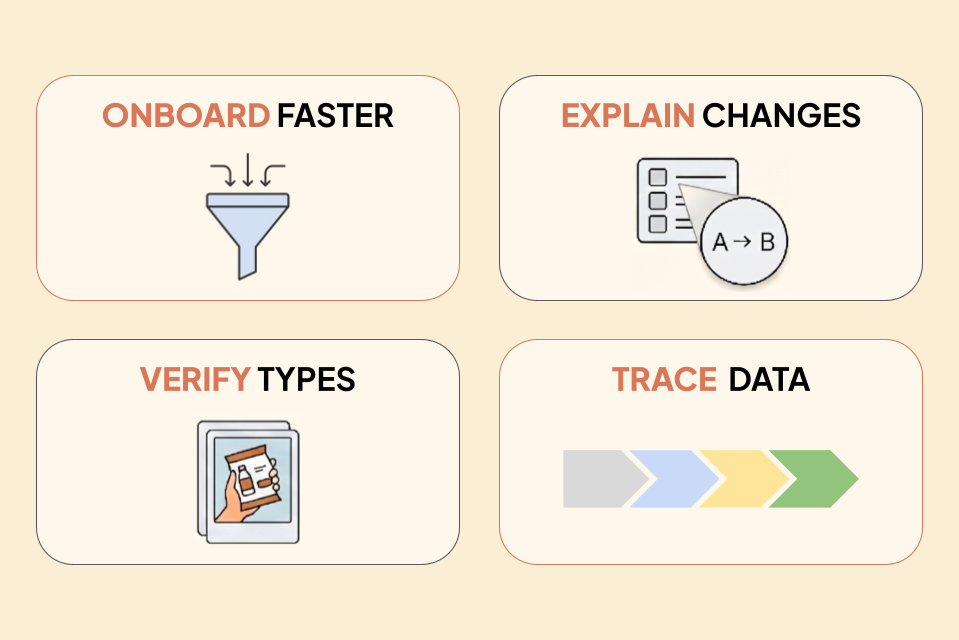
- Problems it solves: Determining readiness to onboard a new data source took days. Also, the onboarding review was limited to human sampling, leading to sub-optimal results. The primary culprit: GTIN values from most data sources often have non-standard values, mutations we haven’t seen before, and misassociated IDs.
- What it does: Establish a confidence level for each new data source in 5 areas, with an action plan for any gates not passed. Performs multiple validations for all product records, cross-referencing other authoritative sources versus the new source.
- Why it's useful: Enables about 10x more sources to be onboarded in the same period of time, with increased accuracy by eliminating sampling.
- Skill name: new-data-source-readiness
Data Analytics Skill
Are images correctly typed by the source?
- Problems it solves: Brands and retailers tag image types — such as front, back and hero — using proprietary codes, which we have reverse-engineered. Because AI is expensive and limited in its ability to correctly identify image types, we manually inspect samples to validate the correct assignment of image codes to images types for higher accuracy.
- What it does: Generate a user tool for large-batch visual inspection of images across products, by image type and data source.
- Why it's useful: Higher accuracy of image typing due to validation of more sample images.
- Skill name: inspect-images
Engineering Skills
Generate useful error messages
- Problems it solves: API error messages in the software industry are often cryptic and not actionable. Hard-coded errors are hard to manage. Engineers are not always the best writers :-).
- What it does: Read the code to understand possible errors. Generate error messages using a style guide provided by Product Management. Test against known accurate outcomes.
- Why it's useful: Useful, consistent error messages for internal & external users across hundreds of scenarios.
- Skill name: useful-error-messages
Explain the change
- Problems it solves: Data set comparisons tell what changed in aggregate, but don’t reveal why. Digging into details manually to find the reason(s) is a fishing exercise with mixed results.
- What it does: Sample the data changes and recorded contexts, analyze cause(s), and summarize findings.
- Why it's useful: Evaluate whether changes are good, bad, or noise. Avoid manual heavy-lifting.
- Skill name: diffs-compare
Trace a complete product record
- Problems it solves: How did a curated product record come to be, after myriad updates from diverse sources, transformations, enrichments, and over time?
- What it does: Get a curated product record and explain how each field's final value was determined, including data sources considered and the reasons for competitive selection.
- Why it's useful: Chasing data through a pipeline used to require joining multiple data sets and reading logic on a field-by-field basis. Now it's one command and a per-field explanation. Much faster for debugging and useful for demos.
- Skill name: elevate-trace
Sales Skill
Enrich outbound contacts
- Problems it solves: Getting data about prospects is time-consuming. Existing tools like Apollo and RocketReach are expensive, with scatter-shot results and accuracy.
- What it does: Take a list of names and companies and return LinkedIn profile URLs, likely email address(es), and other information, with confidence levels and other notes.
- Why it's useful: Saves 15 minutes per name due to the prior need to use multiple tools, even in batch mode. Higher quality email addresses because the Skill multi-sources data. Zero cost.
- Skill name: contact-enrichment
Marketing Skill
Flag LinkedIn posts for strong commenting opportunities
- Problems it solves: Commenting meaningfully on relevant LinkedIn posts builds author influence and generates inbound leads. But reading LinkedIn feeds takes time to find relevant posts.
- What it does: Use third-party tools to get posts. Filter for relevance by multiple criteria. Score results. Generate a prioritized list with scored results.
- Why it's useful: Saves 15 minutes daily to find good candidates. Surfaces better opportunities by ingesting and scoring more posts.
- Skill name: linkedin-post-filter
Here’s how we’re doing it. These approaches may be useful to you.
The key to Skills success is:
Empower people to use Skills for better results with less effort.
For Management
It starts at the top. When the team sees you using Skills or recognizing others, they'll feel encouraged to try new things. AI is scary to many. You can reduce their fear.
- Ask who's already using Skills. Some team members are likely already using Skills. Ask them to share their experience. Collect examples and learnings about existing progress.
- Host "Skills Show and Tell". It's motivational for all and brings real applications to light.
- Encourage all departments. It's not just for Engineering. Our examples above demonstrate that Skills can impact every area.
- Recognize accomplishments, even little wins. Your attention is what matters. Narrow solutions can be useful. Ask if the benefits can be quantified. (You'll be surprised!)
For Individuals & Management
Here are a few guideposts to get started easily.
Today, AI agents are deeply embedded in Foodgraph’s CPG product data platform.
- Our schema, processes, and workflows were fully reengineered as “AI Native” early last year.
- We now choose “AI First” when AI's benefits exceed traditional approaches.
- Most notably, our Context Graph for CPG records decision traces — and most importantly — the decision reasons that advance our data quality, scale, and flywheel effects.
Skills are a new type of AI tool.
- Skills enable workers — in any role — to create customized productivity tools.
- Skills instruct LLMs and agents how to do their work.
- Skills have already accelerated Foodgraph’s productivity, quality, and scale.
Skills amplify the role of humans and their domain knowledge.
High Productivity, Low Technical Expertise
“Skills” are natural language instructions for an LLM to execute a series of tasks, without coding skills.
Since Anthropic introduced Claude Skills on October 16, 2025, the company’s product has captured the market’s attention.
- Worthy competitors include OpenAI’s Custom GPT and Google’s Gemini Gems. Each offering has unique strengths. The rate of improvement is rapid and the competition intense.
- The term “Skills” seem to be gaining acceptance as shorthand for any of these customized productivity tools, even when offered by competitors.
Regardless of the product name, “Skills” are a powerful new approach to productivit
work and a potentially revolutionary technology.
Creating and using Skills does not require technical knowledge or changed infrastructure. Getting started is easy and no more difficult than using Microsoft Office and Google Workspace. Becoming an advanced user of Skills develops over time.
Skills can be employed to manage complicated workflows, simplify data wrangling, access expert knowledge, and generate sophisticated output from financial analysis to code reviews, and much more.
Objectives & Principles
Foodgraph already employs Skills to accelerate our business. Our objectives are to:
- leverage our team’s special areas of expertise;
- tackle tough problems; and
- produce better outcomes.
We hold these core principles regarding the use of Skills:
- Skills are a tool, not an authority.
- Skills output is only as good as their instructions and supervision.
- Skills tend to flatter, make errors, and make incorrect assumptions.
- Our team members — not Skills — determine what work is “fit to ship.”
Regarding Skills, our role as managers is to unlock expertise and creativity
that accelerates all areas of the business.
For more about our platform and recent catalog releases, read these blog posts.
Private Label: 20,000 New UPCs for Spring (v52 release)
Retailers are rolling out “Our Brand” products fast to grab higher margins and foster consumer loyalty.
GLP-1 Support: 50 Brands. 4 Strategies
“GLP-1 Support” products are breaking out across grocery aisles. Get the data.
Compare CPG Data Vendors
We asked AI for its assessment. (We think it’s right :-).
I’d love to hear about your work with Skills. Send me a note — or let me know how we can help!
Warm Regards,

David Goodtree
Founder and CEO, Foodgraph
Discover additional articles, updates, and perspectives.

Book a demo today to learn how Foodgraph can help.